One of the ideas I kept coming back to during my half-marathon training this year was:
Give it everything it needs, and it’ll give you everything it’s got.
I liked thinking about my body that way.
I wanted to beat the 1:35 I ran last year. So I needed a plan, and I needed to train hard. But I also needed to give my body what it needed to actually do the training: enough food, enough rest, and enough recovery.
So that’s what I tried to do. Then, on race day, I asked everything of it. And it gave me everything it had.
I finished in 1:31:33—a personal best by more than three minutes.
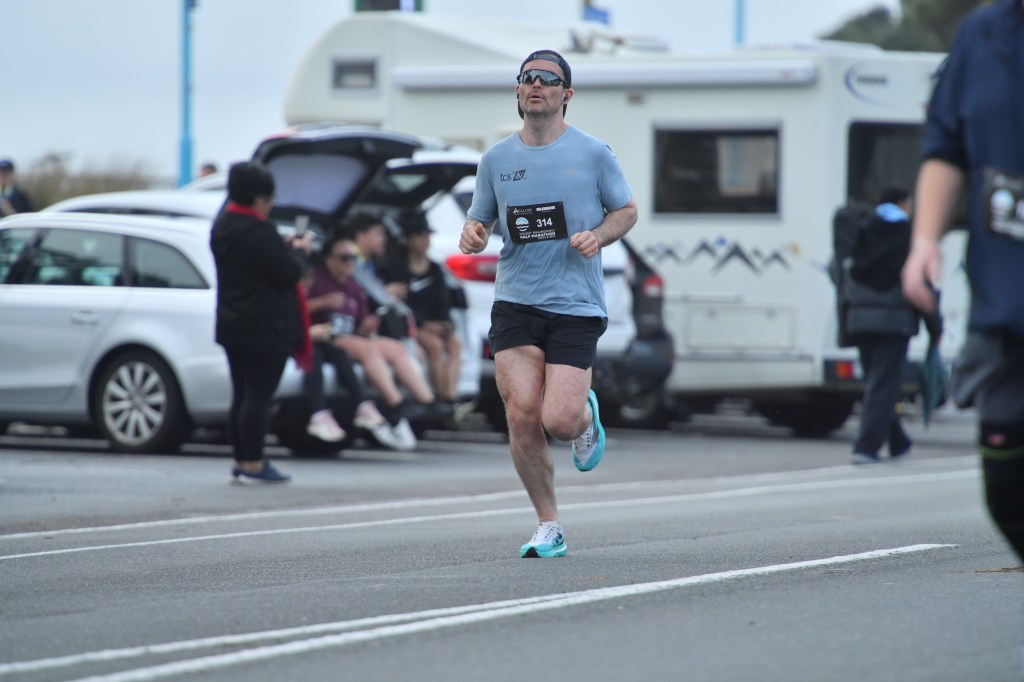
For most of that hour and a half, I’d experienced my body through what it was doing: breathing, moving, hurting, holding pace and eventually getting me across the finish line. I was tired, but I was proud.
About five minutes later, someone I knew crossed the finish line.
I hadn’t realised he was there. I remember seeing him and having that little moment of, oh, he’s running too. Pretty quickly, though, my mind turned it into a comparison. I’d run faster than him, even though he was much leaner and more muscular than I was. Somewhere in there, my achievement started getting mixed up with appearance.
I found myself thinking:
I’d rather have his body and be five minutes slower.
That felt like such a heavy and hurtful thought to have after being so proud of what I’d done.
Nothing about my body had changed in those five minutes. But my experience of it had.
The same body, a different experience
I think that moment says something important about body image. My body had done everything I’d asked of it, yet I could still look at someone else and feel like it wasn’t good enough.
Body image isn’t necessarily one stable way of experiencing our bodies. Different experiences can sit alongside each other, pull in different directions and change as new things enter the picture.
During the race, functionality was front of mind. I experienced my body through movement, effort and capability. My body had done something difficult, and I appreciated it for doing so—something body-image researchers sometimes call functionality appreciation, or valuing the body for what it can do.
Then, after the race, a harmful appearance comparison made me think less of my body. Research has repeatedly linked this kind of appearance comparison with poorer body-image experiences.
Together, those experiences capture some of the complexity, and sometimes the ambivalence, of body image.
A second look
For me, taking a second look means noticing these different experiences as they emerge.
By noticing what had changed and understanding how it had affected my experience of my body, I had a better chance of keeping things in perspective.
Seeing those experiences together reminds me that no single one has to define my whole relationship with my body, and helps me keep sight of the more positive experiences when the negative ones get louder or land harder.
Taking a second look at our body-image experiences isn’t about deciding which one is the “real” one.
My body had given me everything it had.
The comparison just made me question whether everything it had was enough.
And I think that’s exactly why the second look matters.
This article does not constitute personalised advice or professional consultation. For personalised assistance, please consult with a relevant professional. The opinions expressed are solely my own and do not necessarily reflect any organisation’s or individual’s views.

 Darren Elliott, PhD
Leave a comment