Body image is a broad term for how we experience and relate to our bodies. More specifically, it covers how we perceive, think about, feel, and act toward our bodies. Body image can involve appearance or function; the body as a whole or a particular part; and how someone relates to that bodily aspect, all shaped by context.
To make sense of all this, I use three connected ideas: body-image experience, articulation, and networks of body-image experiences.
The first helps us identify a specific body-image experience. The second helps explain how that experience takes form. The third widens the view to consider how several body-image experiences can coexist and relate to one another.
1. Body-image experience
Rather than treating body image as one thing, I see it as particular body-image experiences—the individual experiences through which someone’s body image takes form.
As the figure shows, I understand a body-image experience through four connected dimensions: bodily aspect, component, relationship, and context.
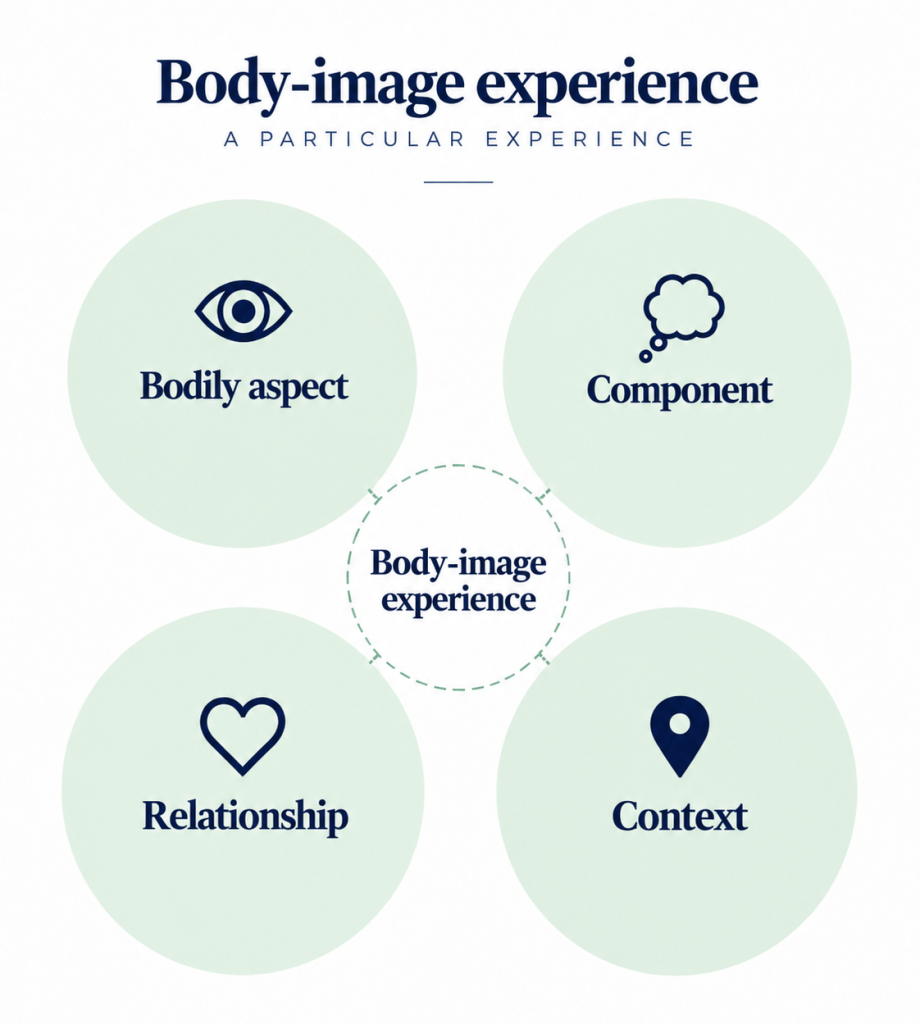
I typically begin with the bodily aspect in focus: the body as a whole or a particular part, considered in terms of appearance, function, or another aspect of bodily life.
The component is what someone is perceiving, thinking, feeling, or doing in relation to that aspect, and a particular experience may involve one or more of these.
The relationship is how they’re relating to it—perhaps through dissatisfaction, appreciation, ambivalence, concern, pride, acceptance, shame, indifference, or something else.
Context is the circumstances in which the experience occurs: the person, period, place, and practice involved, alongside relevant internal and external influences.
I separate these dimensions because doing so helps us see what’s happening. In lived experience, however, they’re closely interconnected and may operate together in messy ways rather than individually.
2. Articulation
Once we have identified those dimensions, the next question is: how do they come together to form a particular experience?
This is where articulation becomes useful. Not every element within each dimension is active at once. Instead, certain elements come to the fore and become connected in a particular configuration.
Articulation asks not only which elements are connected, but how they relate to one another, and what body-image experience takes form through those relationships.
The two examples shown here both fall under the broad term body image, but different body-image experiences take form because different elements connect and relate in different ways.
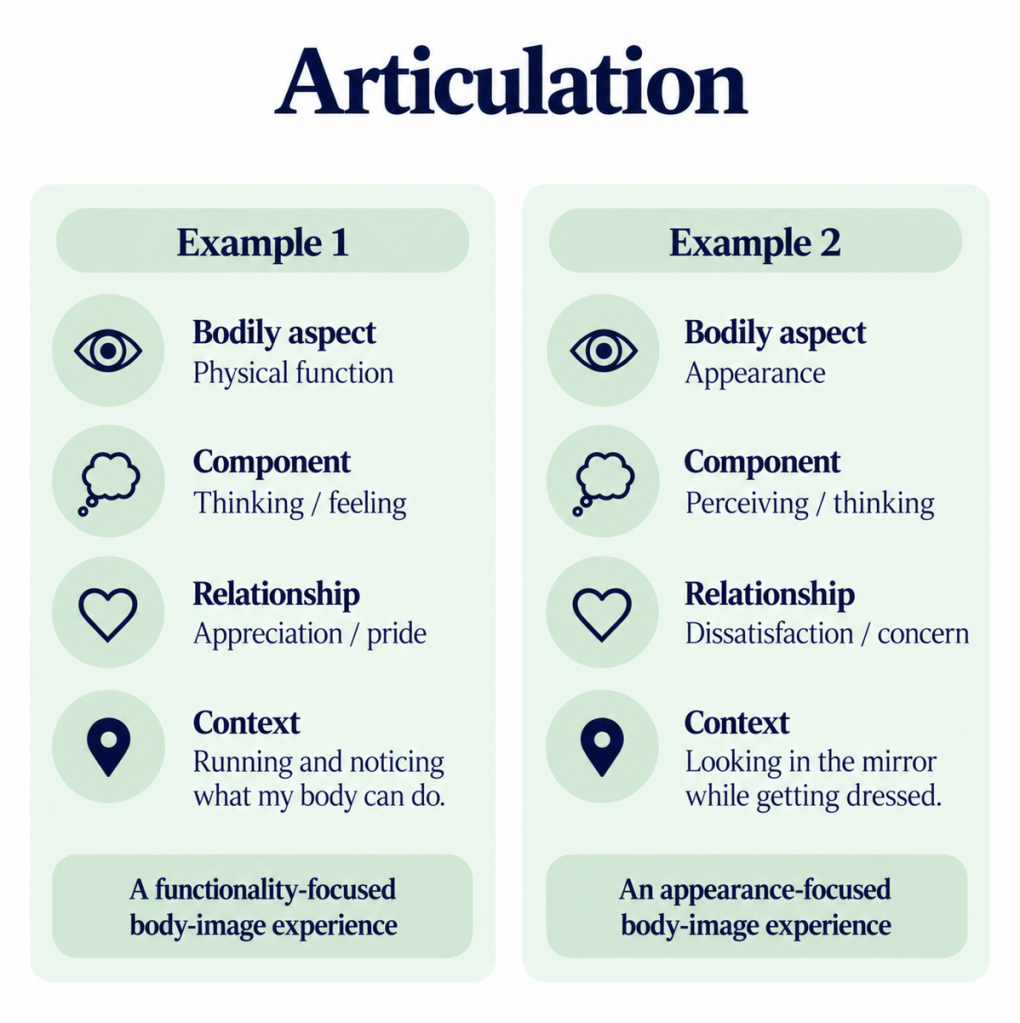
More broadly, articulation can help explain why some body-image experiences recur and seem relatively stable, while others are more fleeting or change across contexts.
So, a body-image experience is a particular configuration of elements within the four dimensions.
3. Networks of body-image experiences
The picture becomes broader again because our embodied lives are not made up of one isolated body-image experience at a time. Several experiences can coexist within a particular context.
For example, someone at the gym might appreciate their strength, feel proud of their progress, be unhappy with their stomach, accept some limits, worry about how others see them, and barely think about other body parts. I call this a network of body-image experiences.
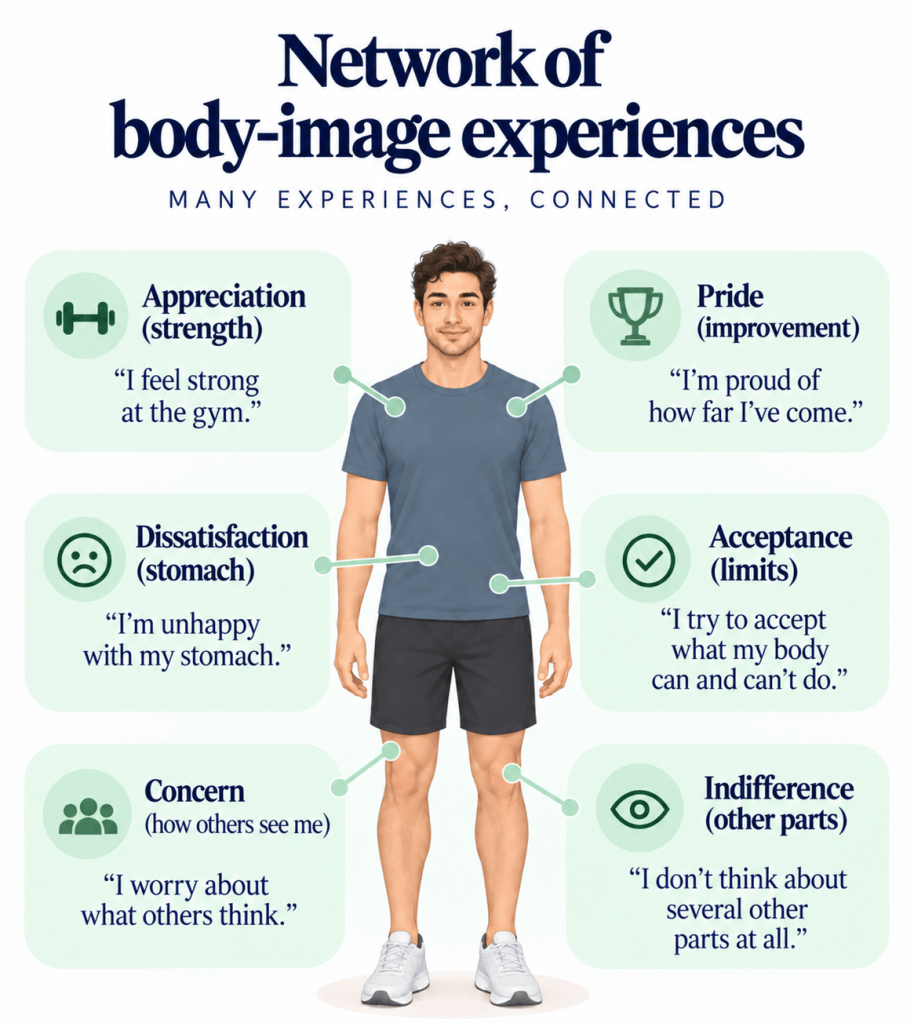
We can then ask how experiences within the network are articulated in relation to one another: whether they, for example, reinforce or conflict with one another, coexist, become more or less salient, or change what another experience means.
Through these relationships, particular experiences may also shape or transform one another, sometimes giving rise to new body-image experiences.
For instance, the experiences above may bring different ways of experiencing and evaluating the body into relation, prompting comparisons between how the body feels to the person and how they perceive others to be viewing or responding to it. This may, in turn, give rise to a new, ambivalent body-image experience.
Bringing the pieces together
Importantly, neither a single body-image experience nor a particular network should be taken to represent someone’s body image as a whole. Body-image experiences belong to a broader embodied life, and no single experience—or even collection of experiences—is likely to capture that life in full.
Thinking about body image this way, however, gives us something more concrete to grasp. We can be precise about a particular body-image experience, widen the lens to examine how multiple experiences coexist and interact, and still recognise that neither represents the whole of embodied life.
It also gives us language to understand both stability and change—across moments, contexts, periods of life, and the relationships between experiences. Taken together, this provides a clearer conceptual terrain for navigating something as multidimensional and complex as body image.
Body image, then, isn’t necessarily just something we have. It’s something we experience.
This article does not constitute personalised advice or professional consultation. For personalised assistance, please consult with a relevant professional. The opinions expressed are solely my own and do not necessarily reflect any organisation’s or individual’s views.

 Darren Elliott, PhD
Leave a comment